October 22, 2026
5:30–6:30 p.m.
Register for this session(opens in a new tab)Rice's Master of Civil and Environmental Engineering is built for managers, practicing engineers and consultants who want to protect the places people live, whether you're finishing a degree or already working.
October 22, 2026
5:30–6:30 p.m.
Register for this session(opens in a new tab)November 19, 2026
12:00-1:00 p.m.
Register for this session (opens in a new tab)Spring Session to be announced
(opens in a new tab)Specialize in designing structures that withstand earthquakes, hurricanes and floods, or protect water, air and soil from contamination.
Every MCEE applicant is considered for a merit scholarship of up to $30,000 toward tuition reduction. Awards are shared in admission letters.
The world's energy capital runs on infrastructure and is one of the best places to be a civil or environmental engineer.
Rice MCEE graduates design buildings and infrastructure, investigate why structures fail, develop solutions for environmental remediation, advise companies on environmental risk and sustainability and lead engineering teams.
Career paths:
What can you specialize in with a Master of Civil and Environmental Engineering at Rice? Choose one of two specializations and build depth in the work you want to do.
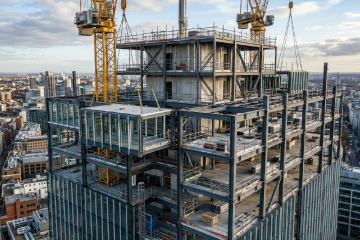
Design buildings, bridges and infrastructure that stand up to earthquakes, hurricanes, flooding and other extreme events.

Protect water and air, clean up contaminants and cut the environmental impact of how cities are built and powered.
The Master of Civil and Environmental Engineering requires 30 credit hours at the 500 level or above. Choose structures or environmental engineering and sustainability, then study full-time or part-time in a 30-credit-hour, non-thesis program. At least 24 credit hours must be taken at Rice.
Put it all into practice
Your final project applies engineering fundamentals to design a civil infrastructure system or fix an existing problem under the constraints you'll see in industry. Rice's Center for Academic and Professional Communication helps you write and present it.
Representative courses: Structural and Resilient Civil Infrastructure
Design prestressed concrete members and systems for axial, shear, torsion and bending loads. Calculate and control deflection using current design codes and standards.
Learn bridge systems, materials, loading and reliability-based design. Then design, analyze and retrofit bridges for seismic and coastal threats.
Analyze how structures respond to ground motion and apply seismic and performance-based design through case studies. Assess seismic hazard and risk with probabilistic methods.
Representative courses: Environmental, Sustainability and Climate Resilience
Learn the physical and chemical principles that govern how contaminants move through water. Apply them to natural and engineered systems.
Choose and apply full-scale technologies to clean up contaminated soil, groundwater and surface water, from risk-based goals to cost and regulation.
Study how gases and particles form, change and move in the atmosphere, from urban ozone and particle pollution to global climate change.
Applicants should prepare:
Structural Engineering and Resilient Civil Infrastructure: a BS in civil, mechanical or a related engineering field with preparation in structural mechanics
Environmental Engineering, Sustainability and Climate Resilience: two semesters of calculus and one each of different equations, physics, biology and fluid mechanics, plus a year of chemistry. Some can be waived based on your background. Explore Admission Requirements
Every applicant is considered for a merit-based scholarship of up to $30,000 toward tuition. Additionally, U.S. citizens and permanent residents may explore outside loans and other financial resources through the Rice Financial Aid Office.
Explore Tuition & Financial ResourcesThe Rice MCEE is a non-thesis master's degree program designed for engineers entering industry.
Structural Engineering and Resilient Civil Infrastructure focuses on designing buildings, bridges and other infrastructure to withstand earthquakes, hurricanes and floods.
Environmental Engineering, Sustainability and Climate Resilience focuses on protecting water, air and soil and cleaning up contamination.
Both follow the same structure: six core courses, electives, a seminar and a final project. Prerequisites differ by specialization.
The MCEE is built on coursework and a final project for careers in industry. The MS and PhD are research degrees that require a thesis.
As little as one year full-time. Part-time students take longer.
Yes. You can enroll full-time or part-time.
No. Graduates with a BS or BA in any field of engineering or a related field may apply, including environmental science, chemistry and bioscience. Some students may need prerequisite courses depending on their background.
No. It is strongly recommended, but not required.
No. However, the Center for Career Development (CCD) supports graduate students at every stage of their career journey, from identifying professional goals to navigating the job market. CCD services include one-on-one career coaching, resume and CV review, interview preparation and access to Rice's global alumni and employer network.
Yes. Every applicant is considered for a merit-based scholarship of up to $30,000 toward tuition. Offers are made on a rolling basis.
Yes. The spring applications are due October 15 and fall applications are due December 15.
Up to 6 credit hours (two courses) from accredited programs offered at universities of similar standing may be applied.
Registration for new students begins during orientation week via Esther. Your login information will be sent from graduate@rice.edu once your application is processed.
You’re billed for tuition and fees when you register. Rice offers a payment plan that spreads payments across the semester. See the Bursar's Office for details.
For more detailed information about admissions, please visit Graduate Admissions (opens in a new tab) .
Applications open September 1. Offers and scholarships are made on a rolling basis, so apply early.
| Start term | Deadline |
|---|---|
| Spring 2027 | October 15, 2026 |
| Fall 2027 | December 15, 2026 |
Resilient cities need engineers who know how to build and protect them. Apply by December 15 to start in fall 2027.
Have questions?
Join an information session, request more information or contact us at mcee@rice.edu.