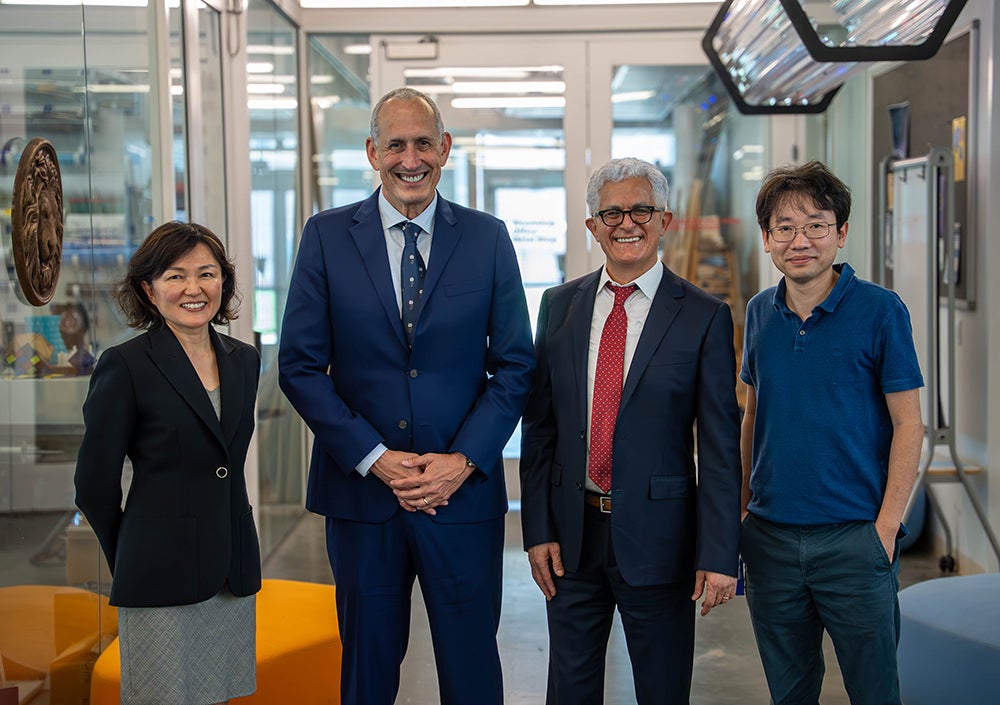
L to R: Qilin Li, Pedro Alvarez, Menachem Elimelech and Shihong Lin.
Access to clean, affordable water is essential to public health, global security, economic prosperity and quality of life. Yet growing populations, changing water demands and climate-related extremes are placing increasing pressure on water supplies and the infrastructure used to treat them. Aging treatment plants, rising energy costs and environmental disasters underscore the need for new approaches to water management.
To address these challenges, researchers in the Department of Civil and Environmental Engineering (CEE) at Rice University’s George R. Brown School of Engineering and Computing are developing technologies that rethink how water is treated, reused and recycled.
Through multidisciplinary research and industry collaborations, our researchers are exploring ways to move beyond large-scale, energy-intensive treatment processes toward more compact, sustainable systems that can serve households and industries while recovering valuable resources.
Jamie Padgett
Stanley C. Moore Professor and Chair, Civil and Environmental Engineering
Building on a legacy of nanotechnology research
Rice’s leadership in water technology is built on a history of scientific discovery. In 1985, Rice scientists Harold Kroto, Robert Curl, and Richard Smalley discovered buckminsterfullerene or "buckyball," a spherical carbon molecule shaped like a soccer ball. The discovery helped establish a new direction in nanoscience, a field that continues to inform research across engineering and materials science.
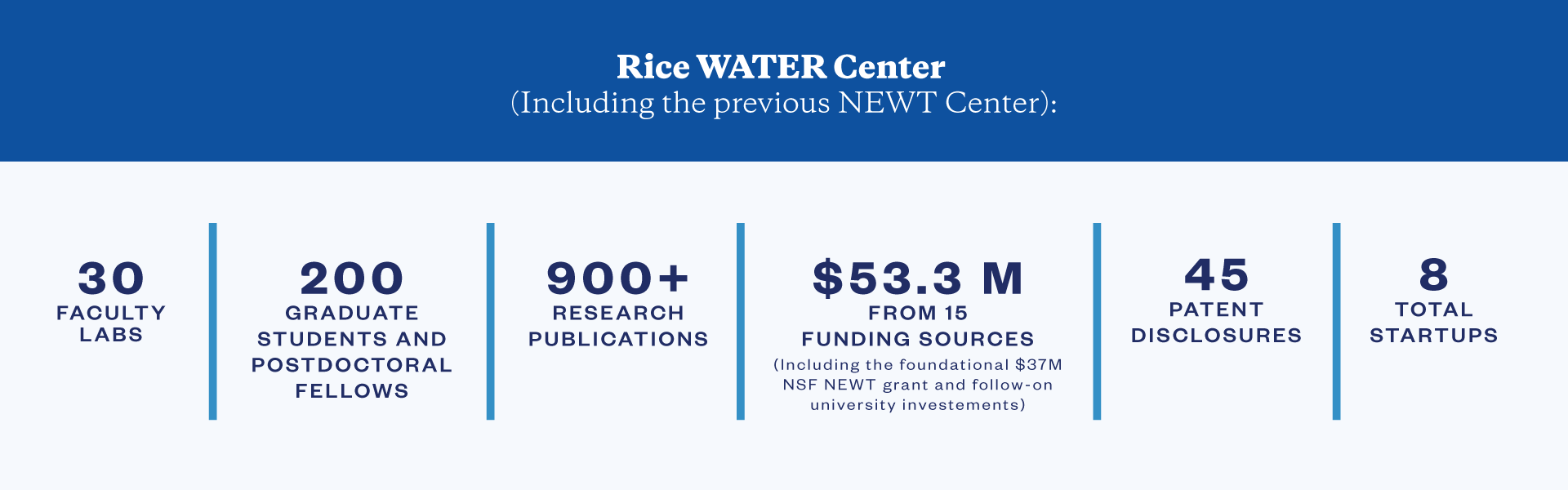
In 2015, Rice launched the Nanotechnology-Enabled Water Treatment (NEWT) Engineering Research Center. This multi-institutional center was directed by Pedro Alvarez, a pioneer of selective "trap-and-zap" technologies that capture and degrade persistent chemical pollutants. Over its decade of operation, NEWT developed compact, off-grid water treatment systems and collaborated with more than 30 industrial and governmental partners, including NASA, Shell, and the U.S. Army Corps of Engineers. Among its developments were trailer-mounted, nanophotonics-enabled solar distillation units designed for remote industrial sites and disaster-relief operations.
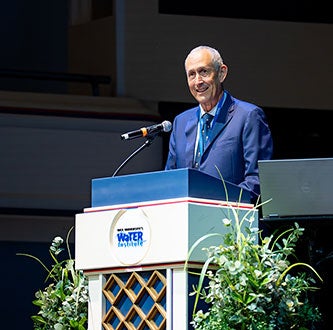
Building on NEWT's success, Rice expanded its water research efforts in 2024 with the Rice WaTER (Water Technologies for Environmental Resiliency) Institute. Led by Alvarez, the institute accelerates the development and deployment of affordable, sustainable water technologies that support public health, resource recovery and a more circular economy.
Clean water is becoming increasingly scarce around the globe and so, we need to find smart ways to increase its supply through conservation and reuse. To make clean water accessible and affordable, we are developing compact and intelligent water purification and recycling methods that will use less energy and toxic chemicals than current methods.
Pedro Alvarez
George R. Brown Professor of Civil and Environmental Engineering and Director of the Rice WaTER Institute.
The institute’s work spans three interconnected areas: safeguarding public health, strengthening municipal water infrastructure, and treating industrial wastewater to recover water and valuable resources.
Safeguarding Public Health and Eradicating Emerging Threats
As industrial pollutants and emerging pathogens increasingly threaten drinking water safety, Rice WaTER Institute researchers are creating real-time monitoring tools and point-of-use destruction technologies to monitor and neutralize health hazards at the source.
In 2020, Lauren Stadler established a partnership with the Houston Health Department to develop and implement a citywide wastewater monitoring system for Houston. The program was named an inaugural Center of Excellence for the Centers for Disease Control and Prevention's National Wastewater Surveillance System. Stadler’s team advances research on sensitive and specific detection of pathogens in wastewater to disease outbreaks, providing timely alerts to public health officials and to the community.
Her research also examines how antibiotic resistance spreads through microbial communities and how to engineer microbial communities in our water systems so they are more resilient and sustainable.
Building strong partnerships with local, regional and national agencies has allowed us to translate our research findings in real-time to benefit the broader community and promote public health," said Lauren Stadler, associate professor of civil and environmental engineering.

Rice researchers are also developing advanced materials that could help protect water quality and infrastructure, and produce clean water from non-traditional sources. Bezawit Getachew, develops smart, self-healing materials and organic-inorganic hybrid materials for water treatment technologies. The self-healing materials can recover from physical and chemical damage, increasing the longevity of water distribution infrastructures like pipes and prevent the leaching of toxins into water supply. The hybrid materials are resilient to oxidants and other harsh conditions, while retaining their selective properties, a key requirement for water treatment membranes.
Research in the Getachew lab ranges from fundamental work on self-healing chemistries to membrane technologies that are ready for technology transfer.
“Accounting for environmentally relevant conditions early on and at the fundamental level as we developed new materials has helped us produce novel and smart materials with tremendous potential for real-world translation and scalability.” said Bezawit Getachew, assistant professor of civil and environmental engineering.
Another priority is addressing PFAS, or per- and polyfluoroalkyl substances, often called “forever chemicals” because of their persistence in the environment. Rice WaTER Institute researchers, in collaboration with the Department of Civil and Environmental Engineering, launched the RicePAR (PFAS Abatement and Replacement) Center of Excellence to address PFAS contamination through research spanning contaminant characterization, site remediation, infrastructure upgrades, and safer alternatives to non-stick materials. Led by Michael Wong, Tina and Sunit Patel Professor in Molecular Nanotechnology and professor in chemical and biomolecular engineering, the RicePAR center also builds partnerships with the semiconductor industry, universities, and commercial laboratories to move promising PFAS-related technologies towards practical applications.
Building Resilient Municipal Water Infrastructure
To help communities withstand climate extremes and water scarcity, Rice researchers are using advanced hydrology, novel materials, process modeling and digital twin technologies to develop modular, autonomously operating systems for on-site water treatment and recycling, as well as smart stormwater management.
Led by Qilin Li, Rice Center for AI-Enabled Water Infrastructure and Sustainable Engineering (Rice-WISE) focuses on developing and implementing on-site systems to treat and reuse household wastewater.
“Water has long been treated as a cheap commodity, while household wastewater has been viewed as a liability—out of sight, out of mind. Yet as clean water grows scarce and aging water and sewer systems deteriorate, reusing wastewater offers a compelling opportunity to turn that liability into a valuable resource.”said Qilin Li, Karl F. Hasselmann Professor of Civil and Environmental Engineering.
Li and her team are developing decentralized treatment technologies that collect and treat household or commercial building wastewater from kitchens, laundry, showers and bathrooms based on their source and level of contamination as well as intended end use. Resources such as nitrogen and phosphorus, which are valuable nutrients used in fertilizers, are recovered for applications including urban farming. For example, lightly contaminated wastewater, (‘graywater’) from bathroom sinks, showers, bathtubs and washing machines are treated at low cost and reused for landscape irrigation and flushing toilets.
Rice has partnered with the Gates Foundation and Yokogawa to pilot autonomously operating systems for on-site wastewater separation, treatment and nutrient recovery in residence halls on Rice campus. The project provides an opportunity to test these approaches in a real-world setting and demonstrate their potential to the Rice community.
Purifying and Recovering Resources from Industrial Wastewater
Meeting the water demands of modern industry and agriculture requires new ways to treat unconventional water sources, from hypersaline oilfield produced water to industrial wastewater. These challenging streams also often contain valuable resources, including salts and critical minerals, that can be recovered.
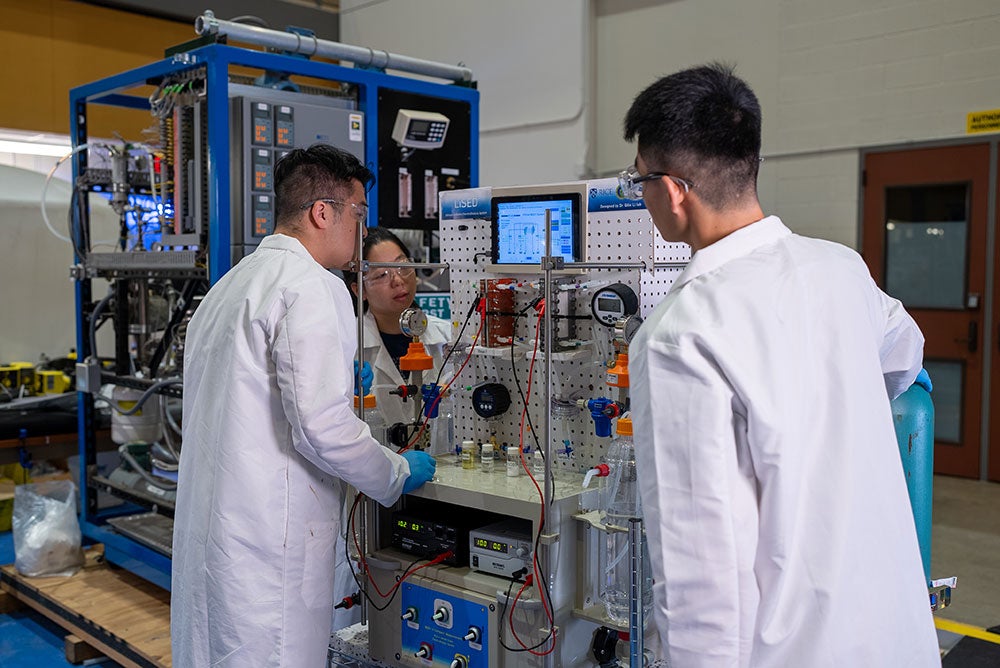
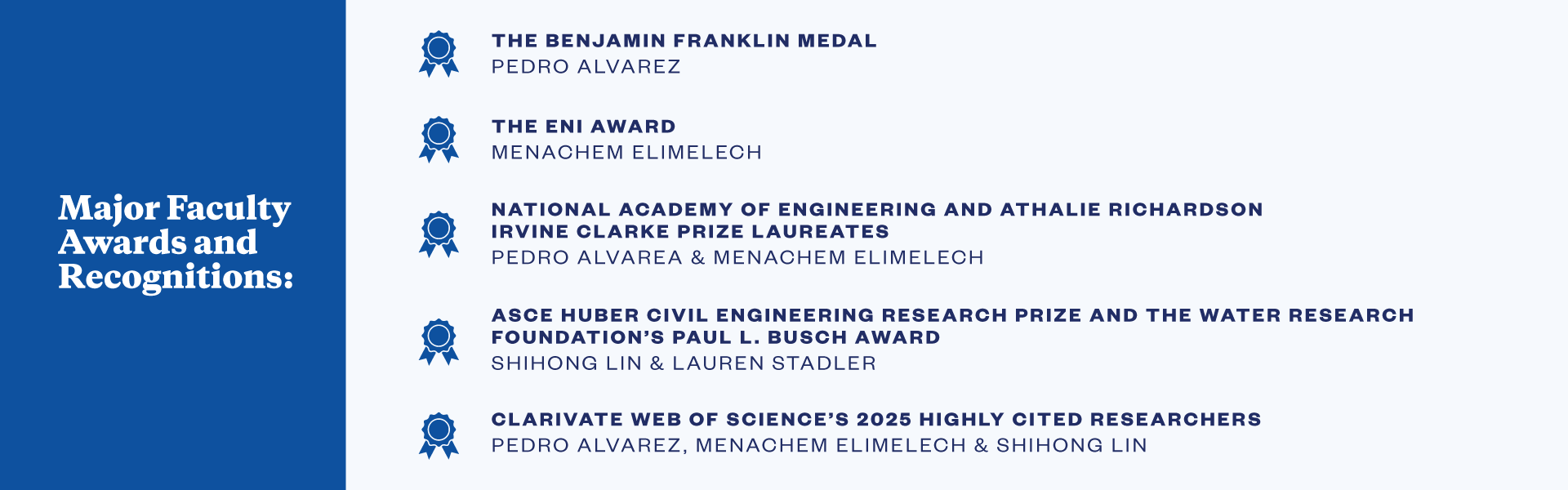
Conventional industrial wastewater treatment methods typically address desalination and decontamination separately, creating costly, complex systems that can produce hazardous brines or metal-laden sludge. At the Rice WaTER Institute, Menachem Elimelech leads the Rice Center for Membrane Excellence (RiCeME), which brings together experts in civil, chemical, biological, and materials engineering to design and deploy next-generation membranes and selective separation technologies. The goal is to treat challenging industrial wastewater streams while recovering usable water, salts and critical minerals.
By pairing fundamental chemical insights with novel membrane materials we develop new membrane and electrochemical separation technologies that turn hazardous industrial wastewater streams into vital sources of purified water, salts and critical minerals.
Menachem Elimelech
Nancy and Clint Carlson Professor in the Department of Civil and Environmental Engineering.
RiCeME builds on fundamental research into brine chemistry and fluid behavior conducted through the department’s Brine Chemistry Consortium, directed by Mason Tomson. These models help researchers predict and optimize membrane performance under demanding industrial conditions, including in highly saline and chemically complex fluids.
“Conventional desalination technologies such as reverse osmosis can remove salts, but they do not selectively separate valuable or toxic metal ions from background salts. Meanwhile, chemical precipitation can remove metals, but it relies on added chemicals and often produces hazardous sludge. We also need new approaches to manage industrial wastewater and promote water reuse, particularly as industries such as semiconductor manufacturing and data centers continue to expand. While conventional municipal wastewater treatment focuses largely on removing organic pollutants and pathogens, industrial wastewater can contain high concentrations of dissolved salts and toxic metals. New treatment technologies should ideally also enable the recovery of valuable resources.” said Shihong Lin, associate professor in civil and environmental engineering
To address these challenges, Lin and his team developed a method called electrochemical ion pumping. The technology is designed to desalinate highly saline industrial wastewater while selectively recovering valuable metals such as copper. It has potential applications in treating wastewater from metal processing, oil and gas operations, and semiconductor manufacturing, as well as certain saline wastewater streams from data center cooling systems.
The future of water treatment will require more than incremental improvements to existing systems. It will require new technologies, new approaches to resource recovery and new thinking about where and how water is treated. Through research spanning nanoscience, chemistry and engineering, Rice researchers are working to make water treatment more adaptable, resource-efficient and responsive to the needs of communities and industries.