
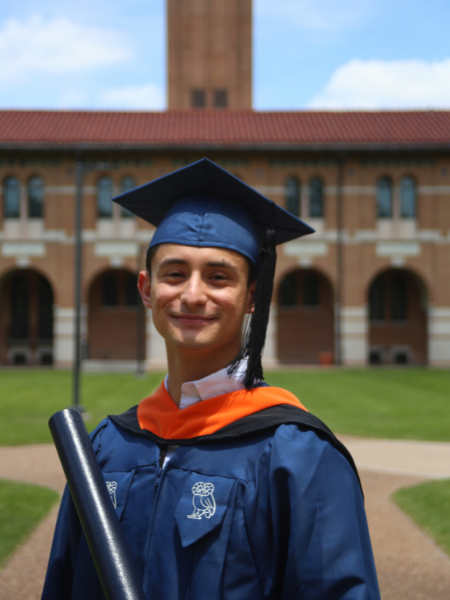
 "I was a senior in my undergraduate program, just thinking about what's next in my life, whether it was full-time work or applying to a master's program," said Rice University alumnus Santiago Gonzalez Bonilla '26. "I had a full-time offer with a construction company as a construction engineer, but I still wanted to keep my options open, especially because I was unsure if that was the field I wanted to go into."
Bonilla had just completed his undergraduate degree at Stevens Institute of Technology in Hoboken, New Jersey, and was weighing that offer against graduate school. A friend introduced him to the GEM Fellowship, which connects students with companies or universities that sponsor their graduate education. Through the fellowship, Bonilla found his way to Rice and its industry-focused Master of Civil and Environmental Engineering (MCEE) program.
He applied to several competitive schools around the Northeast, but Rice stood out.
"Reading about the institution, its history, the type of staff I'd be working with, you could tell the level of academic and professional excellence," he said.
Once he arrived at Rice, the coursework raised the bar.
"It was definitely a step up compared to undergraduate, and the name of the institution speaks for itself," said Bonilla. "The studying was rigorous. It wasn't meant to be easy."
The assignments also required a different kind of thinking. Gonzalez Bonilla was expected to connect technical knowledge to real-world problems, investigate the behavior and cause of collapse/failure of infrastructure and conduct research to develop new cutting-edge solutions for civil engineering problems.
"In undergrad, it was more like, take these variables, put them in the equation, you're done,” he said. "Here, it modeled a more real-life scenario. We had to do research outside of the homework question, gather that information, and apply it to the assignment."
During his two years at Rice, several courses helped shape the way Gonzalez Bonilla approaches engineering today.
Earthquake engineering with Kalil Erazo taught him seismic design from the ground up, starting with how earthquakes generate and how to design infrastructure systems to resist them. "It not only taught the theory and the math, but the course also explained how it would work in a real-life scenario," he said.
A resilience course with Jamie Padgett pushed him further, teaching him how to quantify the risk and resilience from various natural hazards, drawing from concepts of probability and earlier coursework.
His capstone project also showed him that an industry-focused degree did not mean closing the door on research. Advised by Larissa Novelino, Gonzalez Bonilla studied origami engineering, examining how the Miura fold behaved when material was removed from the pattern. It was a research topic he had not expected to encounter in the MCEE program, and one that left a lasting impression: how deployable infrastructure can be used in the aftermath of natural disasters and even space exploration
That technical foundation carried directly into his first job.
Gonzalez Bonilla is now an engineer in the structures group at Thornton Tomasetti, where he began working in summer 2026. The MCEE curriculum gave him a foundation that he could immediately draw on in conversations with colleagues and on the projects crossing his desk.
"I've been able to keep up with other engineers in technical talk, because I've heard these terms before in the classroom setting," he said.
The link between coursework and professional practice is concrete. Prestressed concrete, which he studied in class with Dr. Erazo, now appears in the infrastructure he designs. A final project in advanced structural analysis required his team to develop MATLAB code to analyze 2D frames and 3D space trusses, concepts that now inform the way he approaches building structures.
In his first weeks on the job, Bonilla designed retaining walls, reinforcement layouts for an academic building, and a roof truss. "When they expose you to the real-life work immediately, that's when you grasp the most information," he said.
The MCEE program strengthened more than Gonzalez Bonilla’s technical foundation. It also sharpened the communication and interpersonal skills that have helped him transition into his career with confidence. Nearly every class required a report or a presentation, giving him repeated opportunities to explain technical ideas clearly. His relationships with faculty reshaped how he approached professional interactions. Speaking with professors as peers helped him become more comfortable communicating with experienced professionals, a skill he carried into job interviews, where he treated each conversation as an exchange of ideas rather than a test.
Gonzalez Bonilla began searching for full-time structural engineering positions in January 2026. He stayed open to relocating anywhere in the country and applied to about ten companies. Within months, Thornton Tomasetti extended an offer, and he joined the firm’s Houston team.
"Being able to add on my resume that I'm a Rice alumnus and that I'm part of the MCEE program spoke volumes," he said. "It allows the employer to know I'm more than qualified."
For prospective MCEE students, Gonzalez Bonilla encourages them to take full advantage of the opportunities Rice offers, from professional development events and department seminars to the Houston professional chapter of the American Society of Civil Engineers and certifications such as LEED.
"Take advantage of everything the department offers, and don't be afraid to ask questions,” he said. “Embrace the good times and the bad, the easy and the difficult. Embrace the change, enjoy it, and be active in the Rice community.