

Resilience to disasters is not optional—it is essential to public safety, national security, economic prosperity, and quality of life. Rice University’s Civil and Environmental Engineering (CEE) Department has established a national reputation for tackling one of society’s most pressing challenges: enhancing our understanding of and mitigating the risks posed by natural hazards to our communities and infrastructure. From pioneering work in probabilistic mechanics and structural system identification to breakthroughs in modeling infrastructure interdependencies and multi-hazard vulnerability, Rice CEE researchers have shaped the field and continue to push the boundaries of what is possible in disaster risk, reliability, and resilience.
Our faculty have been historically at the forefront of landmark endeavors across the region and nation—advancing the science of resilience quantification, sparking innovation in predictive modeling grounded in real-world needs, and cultivating a vibrant community built on shared research infrastructure, open data, and accessible models.
Jamie Padgett
Stanley C. Moore Professor and Chair, Civil and Environmental Engineering
Padgett points, for example, to the team’s decade-long collaboration under the NIST Center of Excellence for Risk-Based Community Resilience Planning, which has produced an open, community-scale resilience modeling environment and testbeds in partner communities. She also highlights Rice’s sustained partnership within National Science Foundation’s (NSF) Natural Hazards Engineering Research Infrastructure (NHERI) program to create DesignSafe—the cyberinfrastructure that provides the tools, data, and computing resources needed to accelerate discovery and enhance reproducibility across the natural hazards engineering community. Even closer to home, the SSPEED Center, established at Rice in 2007, has played a visible role in shaping engineering solutions for the Houston and Gulf Coast region’s most persistent flood and hurricane challenges. Together, these efforts have laid a powerful foundation that positions the Rice CEE Department to lead the next era of reliability, risk, and resilience (R3) innovations.
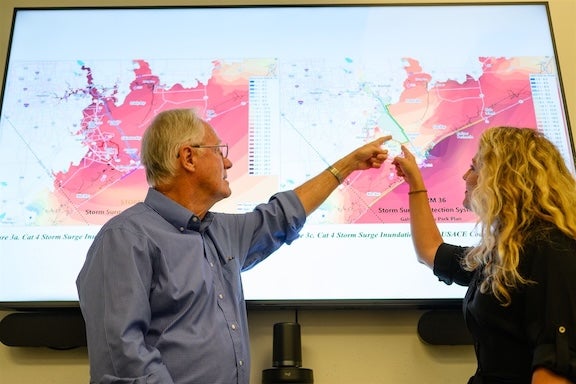
Beyond these major research contributions, CEE R3 faculty have also played influential leadership and service roles that help shape policies regarding risk and resilience at the national level. For example, Leonardo Dueñas-Osorio serves on the National Academy of Science, Engineering and Medicine’s Board on Infrastructure and the Constructed Environment (BICE), advising federal decision-makers on science, technology, and policy related to the safety and performance of critical infrastructure. Similarly, Philip Bedient chairs the academic council of the Interagency Flood Risk Management (InFRM) consortium, which includes the U.S. Army Corps of Engineers, United States Geological Survey, National Oceanic and Atmospheric Administration, and National Weather Service, and helps guide efforts in flood risk mitigation, response, and recovery. Faculty members also contribute through editorial leadership in top journals in the field, such as Pol Spanos’s role as editor of Probabilistic Engineering Mechanics and Satish Nagarajaiah’s service as editor of Structural Control and Health Monitoring. Even the Rice University President, Reginald DesRoches, is a renowned earthquake engineer who has made hallmark contributions to seismic risk mitigation, both through his research and his service roles.
A Forward-Looking View
Building on this legacy of leadership, the department has doubled down on resilience-focused research and education with a renewed, forward-looking vision. Recent faculty hires, expanded partnerships, and bold new initiatives are positioning the Rice CEE Department to accelerate innovation in disaster risk reduction and take on the next generation of challenges facing our communities.
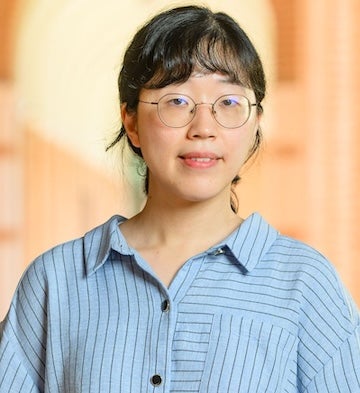
“As a new faculty member, I’m struck by Rice’s deeply interdisciplinary and collaborative research culture and by the complementary expertise of my colleagues to the field of system reliability and adaptive resilience to natural hazards and other system stressors,” said Sang-ri Yi. “Rice’s long-standing unparalleled strength in this area is ultimately what attracted me to the university.”
Yi is the department’s newest faculty hire, specializing in advanced computational methods for uncertainty quantification (UQ). Before joining Rice, she served as an assistant project scientist at the University of California, Berkeley, and as a senior software developer at NHERI’s SimCenter, where she led the development of UQ capabilities for natural hazard modeling and simulation tools. Her addition bolsters the department’s strengths in predictive modeling for large-scale, multi-hazard events and expands its growing portfolio at the intersection of structural and system engineering, artificial intelligence, and machine learning.
Yi joins a series of recent hires who collectively strengthen the department’s R3 area of excellence. Kai Gong and Larissa Novelino, for example, contribute complementary expertise in sustainable and resilient infrastructure materials, as well as in adaptive, rapidly deployable structures. Similarly, James Doss-Gollin has brought new emphasis on climate risk management and decision-making under uncertainty, while Avantika Gori's 2024 addition expanded the department’s capabilities in probabilistic modeling of tropical cyclones and compound, multi-hazard extremes. That same year, Xinwu Qian joined the Rice CEE, bringing strengths in urban mobility and the dynamic behavior of coupled human–built–natural systems under both everyday and extreme event conditions. With joint appointments in CEE and the School of Natural Science's Department of Earth, Environmental and Planetary Sciences, Naomi Vergopolan rounds out this growing team with expertise in computational hydrology and the water-climate nexus.
Leading the Transition to Smart Resilience
Shifting climate conditions, aging infrastructure, rapid technological transitions, and the unpredictability of human behavior present inherently complex challenges to strengthening the resilience and adaptation of communities and their infrastructure. Meeting these challenges requires sustained innovation, creative solutions, deeper fundamental understanding, and improved predictive modeling—and that is where Rice excels.
With its strengthened R3 community, Rice CEE is leading the transition to smart resilience. This emerging paradigm blends cutting-edge technologies—such as advanced computing, artificial intelligence, sensing systems, adaptive designs, and digital twins—with the foundational principles of engineering. At its core, smart resilience is about creating systems and strategies that can learn, adapt, and respond effectively in an ever-shifting world. Rice researchers are doing just that—advancing discoveries that underpin resilient future cities, from the tailored design of carbon-neutral infrastructure materials to the optimal restoration of interdependent infrastructure systems.
Rice’s collaborative research environment accelerates these innovations. CEE faculty member James Doss-Gollin leads the AI4UrbanResilience research cluster within the Ken Kennedy Institute, which brings together engineers, climate scientists, and computer scientists to develop solutions that integrate AI and machine learning with physics-based models. It’s not hyperbole to say that these advances will ultimately save lives.
The result is faster, more precise tools to manage complex systems under extreme weather and changing conditions.
James Doss-Gollin
Civil and Environmental Engineering
Imagine a city equipped with intelligent systems that can forecast not only when a disaster will strike, but how it will unfold neighborhood by neighborhood—activating protections, guiding interventions, and minimizing impacts. Endeavors like the NSF-funded ReDDDoT project led by Padgett are paving the way toward such a future. The team is collectively defining what “responsible artificial intelligence” means in the context of disaster resilience and emergency response, while also building algorithms and tools that improve predictive modeling and situational awareness during coastal multi-hazard events.
Other CEE faculty are bringing new perspectives to smart resilience by harnessing insights captured from satellites orbiting the Earth. NASA-funded research led by Gori examines how satellite data can inform planning efforts in coastal communities. The team is evaluating how remote measurements such as soil moisture, precipitation, and debris accumulation can improve risk estimates and infrastructure impact mapping. Through collaboration with the Houston-Galveston Area Council, these new methods are being tested along the Texas Gulf Coast to ensure that research outputs meaningfully support local planning needs.
Scaling simulations for infrastructure safety and resilience across vast and interconnected critical systems, such as power networks, poses significant computational challenges. Dueñas-Osorio and collaborators are breaking new ground by formulating quantum algorithms for resilience assessment and optimal system restoration. Their work lays the foundation for harnessing quantum computing to address some of the most complex problems in infrastructure resilience.
Partnering for Real-World Impacts
Rice CEE’s commitment to smart resilience extends far beyond the hedges and into the communities that rely on these innovations every day. By collaborating with local, regional, and national partners, faculty are ensuring that scientific advances translate into practical tools, informed policies, and real-world improvements that strengthen resilience where it is needed most.
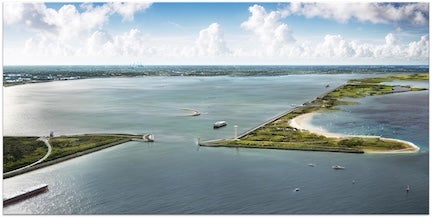
Photo credit: Rogers Partners
The Severe Storm Prediction, Education and Evacuation from Disasters (SSPEED) Center—led by Philip Bedient and Jim Blackburn—exemplifies this mission. SSPEED has delivered some of the region’s most impactful resilience initiatives through sustained partnerships with local stakeholders. One major achievement is the Galveston Bay Park Plan, a visionary coastal protection strategy that integrates structural and nature-based components to enhance navigation, strengthen storm resilience, and improve overall quality of life. The plan emerged from close collaboration and support among SSPEED researchers, industry consultants, philanthropic partners, the Port of Houston, Harris County Flood Control District, and the City of Houston.
SSPEED’s inland work has been equally influential. For decades, its Flood Alert System has safeguarded the Texas Medical Center, which served as the foundation for the City of Houston’s modern Flood Information and Response System (FIRST). These systems provide real-time situational awareness to communities across Houston, where the consequences of severe flooding can be catastrophic.
The FIRST system will soon be expanded to provide vital flood warning in the Hill County of Texas, where unexpected flooding on July 4th of this year resulted in the tragic deaths of around 135 people, including dozens of young girls attending summer camp, and caused massive devastation in the local communities.
Our goal with these projects is to create a generalized framework for flood detection and mitigation strategies that can be implemented across diverse regions of Texas—and ultimately serve as a blueprint for flood resiliency across the entire country.
Philip Bedient
Herman Brown Professor of Engineering
Another way in which Rice researchers are partnering up with local businesses and policymakers is in the area of transportation–a crucial aspect of life in Houston and across the country. Qian brings smart resilience principles into the design of energy-efficient and adaptive urban mobility systems. “We seek to gain a deeper understanding of human-infrastructure coupling dynamics and rethink how infrastructure meets the social and functional needs of the communities it serves,” Qian said. “We are developing tailored network models to support human-centered infrastructure decisions, and design adaptive operational and control algorithms that integrate multimodal mobility solutions at scale, both under normal conditions and in anticipation of extreme events. By co-developing these technologies with local partners, we can accelerate deployment and ensure that real-world constraints inform scalable, resilient solutions.” Examples include an NSF-supported effort to plan and deploy large-scale EV charging stations that explicitly model human travel and charging behavior, and work on managing precautionary charging surges ahead of extreme events.
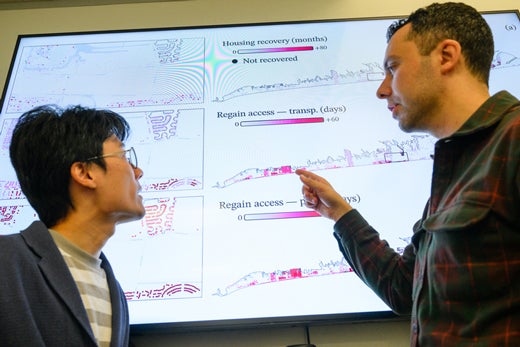
“We also lead a US Department of Transportation/US Department of Energy-supported project to optimize multimodal public transportation operations to better meet human-centered, personalized mobility needs at scale,” Qian said, “It is enabled by learning-based operational algorithms, advanced V2X hardware, and automated-vehicle technologies."
CEE’s R3 faculty are advancing disaster resilience and catastrophe modeling by cultivating deep industry-academic partnerships that accelerate the translation of research. In 2025, Rice and Lehigh University launched the Consortium for Enhancing Resilience and Catastrophe Modeling (CERCat), a national hub uniting university researchers with experts from the insurance, reinsurance, and engineering consulting sectors. Padgett, who serves as CERCat's deputy director, emphasized that the consortium fills a critical national gap: “We are building a unified research and innovation pipeline that connects academic discovery with industry needs, enabling faster, more transparent, and more reliable catastrophe modeling.”
As Rice CEE continues to expand its research portfolio and partnerships, the department is setting a new standard for reliability, risk, and resilience. By uniting engineering innovation, advanced analytics, and collaborative partnerships with industry and communities, Rice is building the knowledge base and technologies that will drive advancements in resilient infrastructure, to cultivate disaster-ready cities for decades to come.